Initial results in the recovery of natural grassland as a response to mechanical weed control in the Santa Catalina Provincial Nature Reserve wetland (Buenos Aires Province)
Keywords:
biodiversity, invasive weeds, protected natural areas, environmental restorationAbstract
The alterations caused by invasive plants are among the causes of the deterioration of natural habitats. In particular, in protected natural areas, management plans for exotic species are established through compatible practices.
The Santa Catalina Protected Natural Area is located in the south of Greater Buenos Aires.
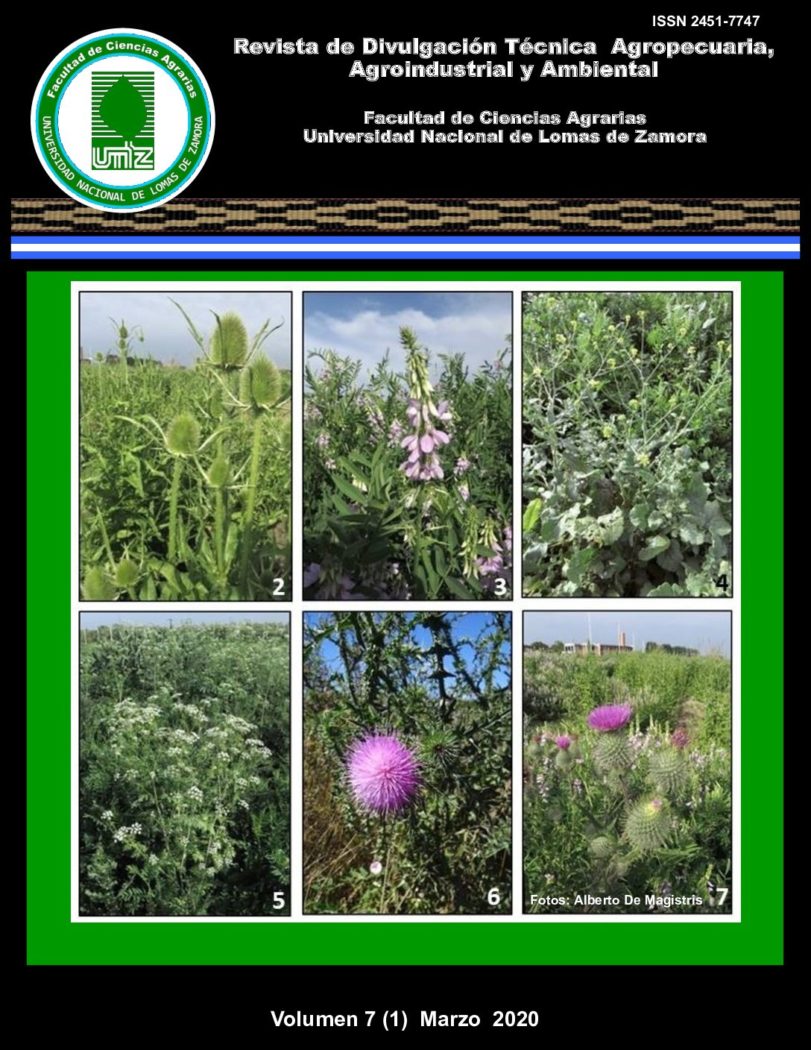
It comprises 650 hectares and is currently being implemented. A rich biodiversity unfolds within a diverse mosaic of environments and topographic conditions. At the same time, it constitutes a prominent site for certain environmental research. The objective was to evaluate the effect of two mechanical cutting methods on weed populations in a low-lying area near the reserve's wetland, as a viable control methodology within the reference area and other similar areas in the region. The experience demonstrated that the practice of frequent cutting that maintained the canopy at less than 20 cm in height significantly favored the recovery of the natural riparian grassland species. The weed community dominated by
Dipsacus-galega was replaced after 20 months by a community of
native species dominated by Cortaderia selloana, Hydrocotyle bonariensis,
Pluchea sagittalis, Calibrachoa parviflora, Eleocharis spp., Salpichroa origanifolia, and
Solanum spp. It is estimated that, on a real-world scale, this technique could be implemented
through 5 to 6 annual cuts with a trailed brush cutter until the
desired reduction of the weed community is achieved.