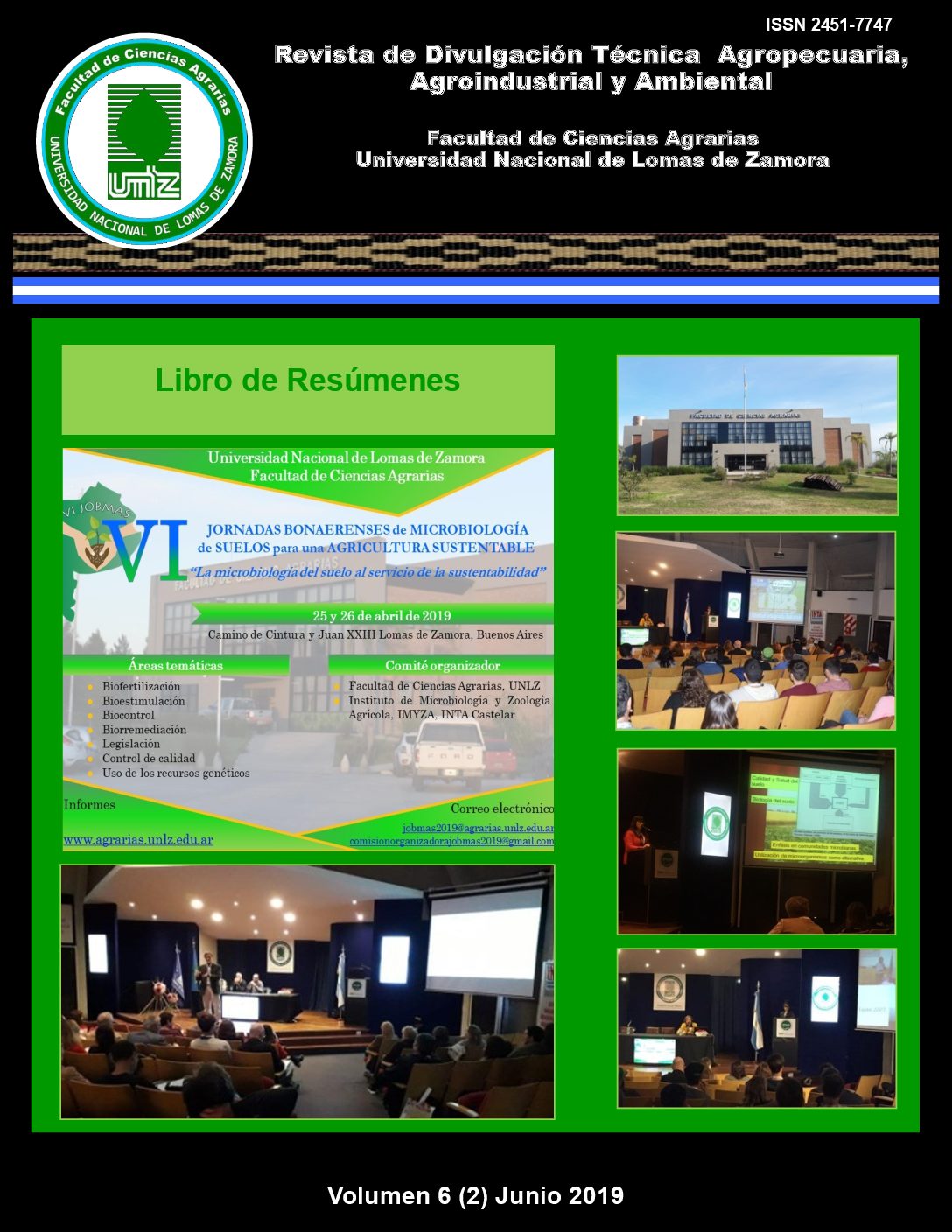
Book of Abstracts
Abstract
Contributing knowledge to agricultural sustainability in the Buenos Aires region since 2007. Susana M. Carletti.
JOBMAS approaches and perspectives: producing with a smaller footprint. María Flavia Luna.
New paradigms in agricultural microbiology and soil microbiome management. Luis Wall.
Exploring microbiota in search of bioenergetic inputs. Daniel Grasso.
Sensitivity of microbiological parameters as soil quality indicators: their contribution to sustainable management monitoring. Silvia Toresani.
IICA and CIAO: Institutional support for sustainable production in the Americas. Juan Manuel Gámez.
Organic Production and Edaphic Microbiota: Synergy at the service of sustainable production. Mariano Lattari.
Almost everything you should know about the genus Azospirillum and its impact on Agriculture. Fabricio Cassán, Gastón López, María Verónica Mora.
Antarctic soils contaminated with hydrocarbons: indigenous microorganisms and bioremediation strategies. Walter P. Mac Cormack.
Microbial biofilms of agricultural importance: current status and future perspectives. Patricia L. Abdian.
Regulation of the synthesis of the two flagellar systems in Bradyrhizobium diazoefficiens. Elías Mongiardini.
The double face of auxin metabolism in Bradyrhizobium japonicum. Daniela Torres, Florencia Donadío, Fabricio Cassán.
Bio-inputs: Registration of Biological Fertilizers, Conditioners, and Amendments in Argentina. Carla Louge.
REDCAI's contribution to quality control for agricultural bio-inputs. Silvia Toresani.
CABUA: Promotion policies for the development and use of bio-inputs in the Argentine agricultural system. Roberto Alfredo Barcia.
The Nagoya Protocol and the use of Microorganisms in technological development: progress and challenges in the national context. Cecilia Carmarán.
Lessons learned from crop responses to Azospirillum spp. inoculation under extensive conditions. Martín Díaz-Zorita, Maria Laura Ramos.
Field evaluation results of PGPR organisms in south-central Buenos Aires Province. Martín Zamora.
Management practices to close yield gaps in extensive crops: Contributions from soil microbiology. Gustavo N. Ferraris.
The rhizobium-legume interaction as a tool to reduce dependence on nitrogen fertilizers in agrosystems. Carlos F. Piccinetti.
Co-inoculation of soybean plants with Bradyrhizobium japonicum and Trichoderma harzianum: coexistence of both microorganisms and nodulation in the presence of nitrates. Esteban Tomás Iturralde, Delfina Colla, Anibal Lodeiro, Julieta Pérez Giménez.
Characterization of native isolates of fungi from the genus Cladorrhinum and their potential as antagonists and plant growth promoters. Mara E. Martín.
Arbuscular mycorrhizal fungi: General overview and potential as biological inoculants. Detection and manipulation. Fernanda Covacevich.
Application strategies for antagonists of the genus Trichoderma. Viviana Andrea Barrera.
Spore-forming bacteria with nematicidal activity: their application as biocontrol agents for phytophagous nematodes. Diego H. Sauka.
Glyphosate degradation in soils under different agricultural practices. Marcela Rörig.
Rhizospheric microbial communities associated with glyphosate-treated plants. Inés Eugenia García de Salamone, Jhovana Silvia Escobar Ortega, Agustín Piran Balcarce, Rocío Luz Kolman.
Abundance and diversity of methanotrophic, methanogenic, and denitrifying bacteria, and greenhouse gas production in sugarcane soils under conventional and conservation management. Juan Frene, Marcela Montecchia, Jorge Chalco Vera, Martín Acreche, Luis Ernesto Erazzú, Elisa Bertini, Olga Correa.
Iron nanoparticles: Improving nodulation in legumes. María Daniela Groppa, Nathalie De Valois, Eugenia Gabriela Di Baggio Vega, Myriam Sara Zawoznik, María Florencia Iannone.