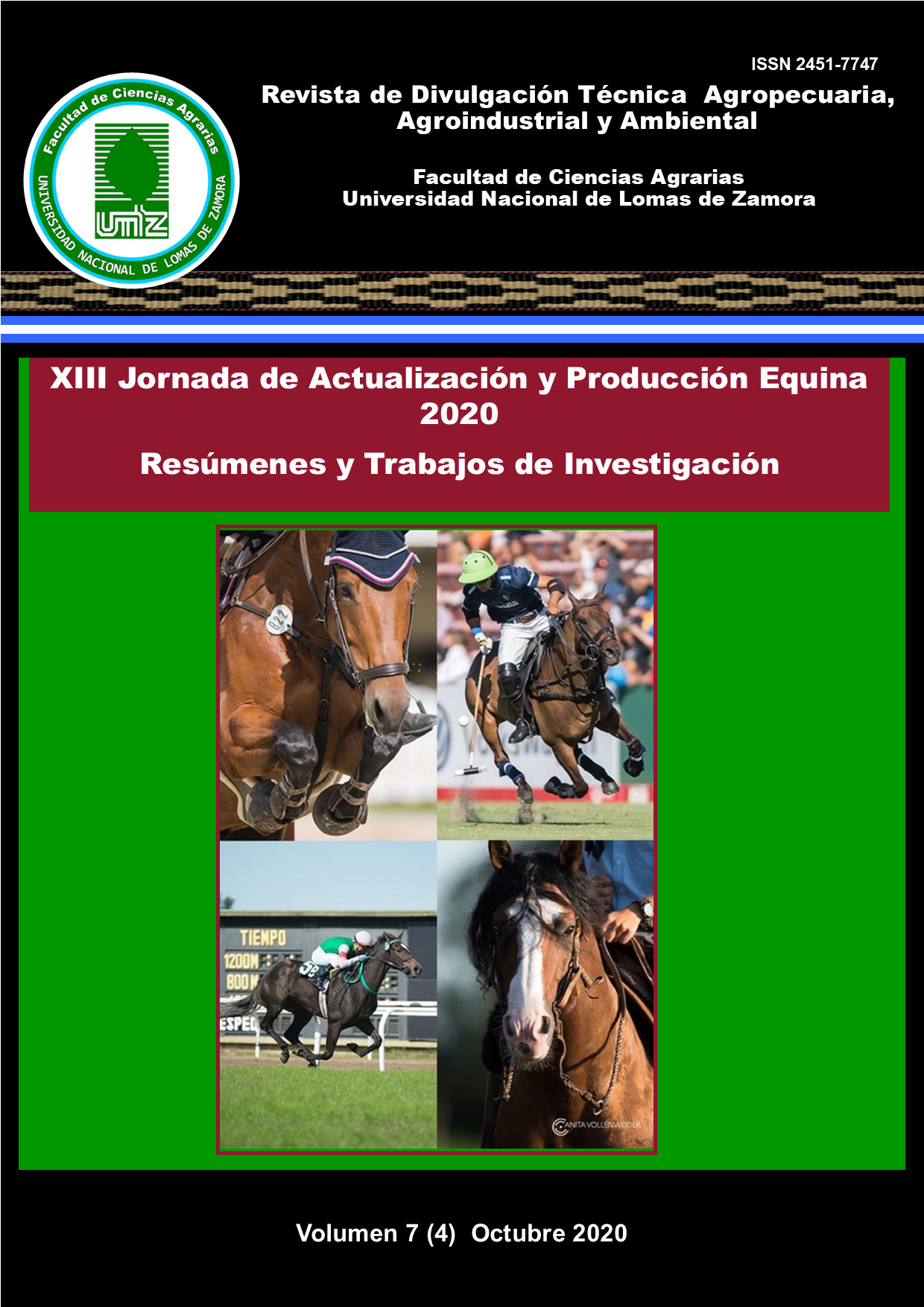
Prevalence and early control of limb conformation in sport horse foals
Keywords:
imbconformation, control alterations, Argentine polo raceAbstract
"Limbs conformation” is generically defined as the alignment that the members present in reference to certain imaginary vertical lines that are drawn with respect to the plane and serve as guides in the evaluation of part of the conformation of a horse. When we refer to deviation sof poise, we include in this group a large number of clinical manifestations tha thave a multiplicity of causes and that most of them are unknown, so it isdifficult to group them into a single set of pathologies with one cause in common. The prevalence has been described in multiple reports and a great variability of information is found between studies. The Polo Argentino breed, on which the research work that gives rise to this article is based, lacks (like many other breeds in Argentina) formal descriptions of the prevalence of defects of poise. In the present study, 8128 controls were made on foals in five birth seasons of theArgentine Polo Breed foals. Considering the total of foals as a whole, they represent approximately 24% of the total of foals registered per season in Argentina. The statistical analyzes were 4: Analysis on the total of the defects seen, without considering the age, Analysis on the total of the foals with / without defects, considering the age, Analysis on the relationship between age and the degree of each defect and Analysis of the relationship between age and the degree of each defect. The control of the alterations of the legs in a breeding establishment includes four relevant points: 1) Early, precise and timely diagnosis, 2) Right time to treat each particular defect, 3) Choosing the appropriate treatment considering the type and degree of the defect and the age of the foal (nothing “generic”), 4) Systematic monitoring of the effect of the treatment to make adjustments in it. It must be remembered that a foal is already a horse and tha tit has it sown particular way of being evaluated and what he defines (orwe are letting him define) in his first months of life will be what determines his potential.